Popper Fly Full Guide: From Head Shapes and Materials to the “Strip–Pause” Rhythm—Understanding the Explosive Aesthetics of Topwater Fly Fishing
Among surface flies in fly fishing, the Popper Fly (popping fly) is almost the most visually striking category. It does not win by slow subsurface swimming; instead, its flat, cupped, or slanted head strikes the water during a fast strip, producing “pop-pop” explosions, splashes, and wakes that call predatory fish from a distance or from deep water straight up to the surface. For the angler, the joy of a popper is not only the hookup but the moment you clearly see a fish charge up from below and blow up on the fly.
But to use a popper professionally, you cannot treat it merely as a “fly that makes noise.” Head shape, material, size, tail dressing, and retrieval rhythm all directly affect its sound, posture, and best-use scenario.
1. The Core Logic of a Popper: Sound, Vibration, and Silhouette
The lateral line system of predatory fish is highly sensitive to low-frequency vibration and can perceive wakes, splashes, and low-frequency “pop” disturbances on the surface. A popper imitates an injured baitfish, a fallen frog, an insect, or a small fish struggling at the surface. Such targets are often out of control and leave obvious ripples and sounds, which easily triggers a reaction strike.
At the same time, the clear silhouette a popper forms on the surface, plus the subtle movement of marabou tails and rubber legs at the pause, further reduces a fish’s wariness. An efficient popper is not just loud; it is a combination of sound, wake, silhouette, and pause dynamics.
2. Choosing a Popper by Head Shape: The Cup Determines Its Character
Head design is the most core classification dimension of a popper. It directly determines how the fly displaces water, how loud it is, and what kind of attracting action it produces.
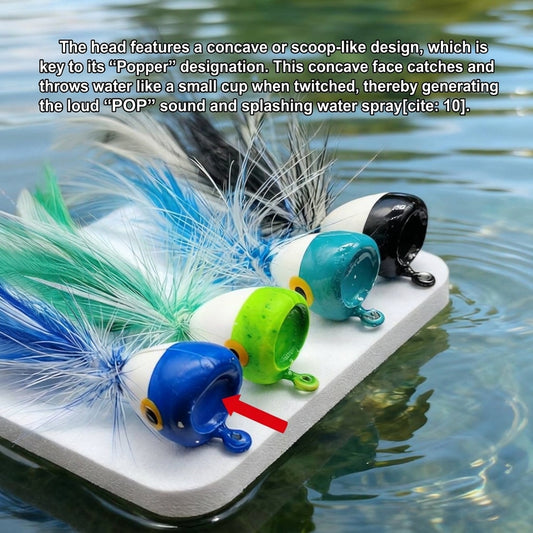
Cupped / Concave Head
There is a distinct concave cup at the front of the head. On a fast strip it cups water and produces a larger “pop-pop” sound and spray. It suits deep water, murky water, or situations where fish must be attracted from a distance. Its blow-up feel is the strongest, and it is the typical popper in the strict sense.
Chugger / Slanted Head
The head is slanted. It does not produce an overly violent explosion; instead, it creates a continuous splash and wake (chugging) with a relatively softer sound. It suits shallow flats, calm surface, or wary fish that should not be startled by loud noise.
Slider / Bullet Head
Strictly speaking, this is closer to the Slider category. It does not rely on popping; instead, it glides in a Z-shaped walk-the-dog motion across the surface, imitating a startled fleeing baitfish. It suits clear water and finesse presentation.
Professional anglers often carry all three types: use a cupped head to search distance or murky water, a chugger for continuous disturbance on a calm surface, and a slider for finesse imitation in clear shallow water.
3. Material Determines Buoyancy, Landing Sound, and Durability
Foam Head
The most mainstream modern material, such as EVA foam or pre-shaped foam heads. It offers high buoyancy, does not absorb water, is bite-resistant, lands softly, and does not need frequent reapplication of floatant. It is suitable for high-frequency use and complex cover.
Clipped Deer Hair
A classic traditional construction. The hollow deer hair provides buoyancy, lands naturally and softly, and sits realistically in the water. After long use it may need floatant. It is better for scenarios pursuing natural landing and a traditional handmade feel.
Balsa / Cork
Traditional hard poppers with good buoyancy and sturdy structure. Surfaces are often painted or lacquered, and they can produce a very loud pop. They are often used for large bass poppers or saltwater poppers. They are relatively heavier, and their landing sound is louder.
4. Size and Target Fish: Bigger and Louder Is Not Always Better
Popper hook sizes and overall dimensions should be selected according to the target fish’s mouth gape, habitat, and forage size.
Micro / Panfish Poppers
Common sizes are #8–#12. Targets include bluegill, panfish, small stream trout, and similar species. The emphasis is on soft landing and small splash.
Bass Poppers
Common sizes are #2–#3/0. Targets include largemouth bass, smallmouth bass, yellowcheek, and similar predators. They balance distance, sound, and hook gap.
Saltwater / Big Game Poppers
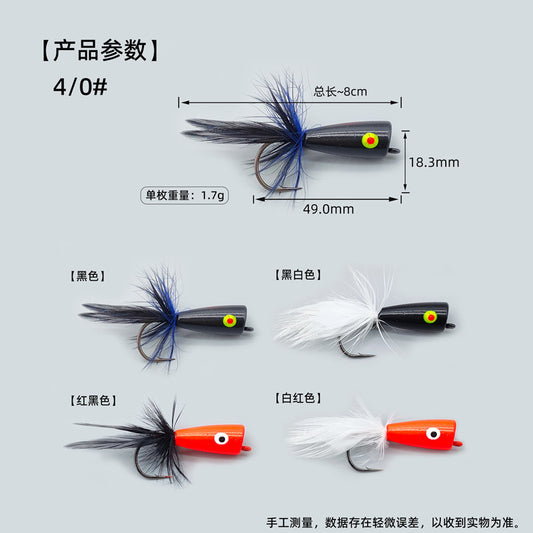
Common sizes are #2/0–#5/0 or even larger, with rust-resistant high-strength saltwater hooks. Targets include GT, sea bass, snook, redfish, and similar species. They require stronger frames, heavier hook wire, and more bite-resistant materials.
5. Tail and Imitation: The “Second Layer of Attraction” at the Pause
The tail of a popper is not decoration. Hackle or marabou tails still produce fine movement at the pause; rubber legs add lateral disturbance and vibration, imitating insect or frog legs; Zonker/streamer tails combine a popper with a streamer profile, dragging out a small-fish or water-snake swimming action on the retrieve.
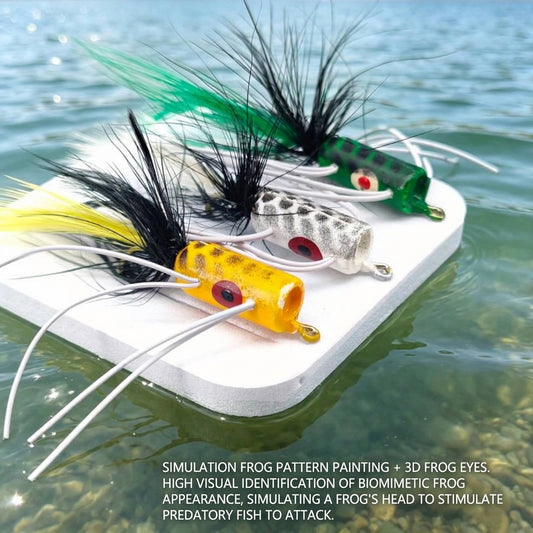
By prey profile, poppers can also be divided into frog, baitfish, and terrestrial insect types. Frog types often use green/brown colors and long legs; baitfish types emphasize silver, white, blue, and black, with 3D eyes and flash; insect types are smaller and imitate fallen cicadas, grasshoppers, beetles, or moths.
6. Practical Retrieval: Pop–Pause Is the Soul
The classic popper operation is strip and pause. After casting to key cover such as weed edges, fallen trees, or behind rocks, first let the ripples spread for a few seconds so fish notice the “intruder.” Then use the rod tip to give short, sharp, forceful strips on the fly line, making the cupped head cup water, emit a “POP,” and throw a splash, followed by a brief pause.
Try different rhythms: “Pop—Pop—Pop,” or “Pop-Pop—Pause—Pop-Pop-Pop.” Most violent blow-ups happen at the moment the popper is dead still, not while you are aggressively stripping. Therefore, the pause is not rest; it is part of the attraction.
Ideal scenarios include shallow flats, weed edges, and around cover. A loud pop can draw hidden predators out to attack. But note: in pressured waters, clear shallow water, or calm no-wind conditions, an overly loud cupped head may be counterproductive; at such times a chugger or slider is often more effective.
Conclusion
The charm of the Popper Fly is that it turns fly fishing from “subsurface perception” into a “surface visual game.” Truly professional popper fishing is not about blindly pursuing loud noise and splash; it is about matching head shape, material, size, tail dressing, and retrieval rhythm to water color, wind and waves, fishing pressure, and target cover. Choose the right popper, control the breathing feel of the strip–pause, and you can turn the surface into the most exciting hunting ground.